

BLOG
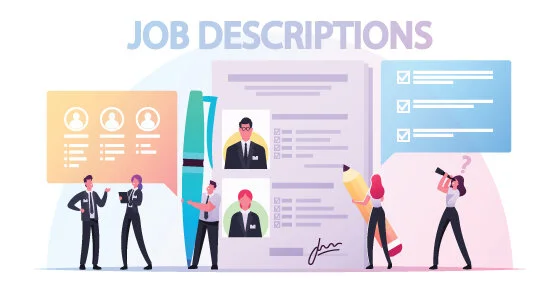
Are your company’s job descriptions pulling their weight?
At many businesses, job descriptions have it easy. They were “hired” (that is, written) many years ago. They haven’t had to change or do anything, really, besides get copied and pasted into a want ad occasionally. They’re not really good at what they do, but they’re used again and again because everyone assumes they’re just fine.
The problem is, they’re not. Outdated, vague or inaccurate job descriptions can lead to longer hiring times, bad hires, workplace conflicts and even legal exposure in employment law actions. So, now the million-dollar question: Are your company’s job descriptions pulling their weight?
Review and revise
There’s only one way to find out: Conduct a thorough review of your job descriptions to determine whether they’re current and comprehensive.
Check to see whether they list outdated procedures or other outmoded elements, such as software you’ve long since phased out. As necessary, carefully revise the wording to describe the duties and responsibilities for a particular position as it exists today.
If you don’t already have formal, written job descriptions for every position, don’t panic. Ask employees in those positions to document their everyday duties and responsibilities. Each worker’s supervisor should then verify and, if necessary, help refine the description.
Put them to work
After you’ve updated or created your job descriptions, you can use them to increase organizational efficiency. Weed out the marginal duties from essential ones. Eliminate superfluous and redundant tasks, focusing each position on activities that generate revenue or eliminate expenses. You may be able to make improvements in other areas, too, such as:
Recruiting. Are you hiring people with the right skills? Up-to-date job descriptions provide a better road map for finding ideal candidates to fill your open positions.
Compensation. A complete and accurate description of the hiring requirements, job duties and responsibilities of a position provide context and rationalization for how that person is compensated.
Workload distribution. Are workloads efficiently distributed among employees? If not, rearrange them. You may find this necessary and beneficial when duties change because of revisions to job descriptions.
Cross-training. Can your employees handle their coworkers’ duties and responsibilities? In both emergencies and non-emergencies (vacations, for instance) — and as a fraud-prevention measure — having workers who are able to cover for each other temporarily is critical.
Performance management. Are employees doing their best? Detailed job descriptions allow supervisors to better determine whether workers are completing their assigned duties, meeting or exceeding expectations and growing with the company.
Stop the slackers
No business should put up with slacker job descriptions that do nothing but hang around the break room exchanging gossip and eating all the donuts. Ensure yours are actively contributing to your company’s success by managing their performance just as you do for real-live humans.
© 2021

Make health care decisions while you’re healthy
Estate planning isn’t just about what happens to your assets after you die. It’s also about protecting yourself and your loved ones. This includes having a plan for making critical medical decisions in the event you’re unable to make them yourself. And, as with other aspects of your estate plan, the time to act is now, while you’re healthy. If an illness or injury renders you unconscious or otherwise incapacitated, it’ll be too late.
To ensure that your wishes are carried out, and that your family is spared the burden of guessing — or arguing over — what you would decide, put those wishes in writing. Generally, that means executing two documents: a living will and a health care power of attorney (HCPA).
Clarifying the terminology
Unfortunately, these documents are known by many different names, which can lead to confusion. Living wills are sometimes called “advance directives,” “health care directives” or “directives to physicians.” And HCPAs may also be known as “durable medical powers of attorney,” “durable powers of attorney for health care” or “health care proxies.” In some states, “advance directive” refers to a single document that contains both a living will and an HCPA.
For the sake of convenience, we’ll use the terms “living will” and “HCPA.” Regardless of terminology, these documents serve two important purposes: 1) to guide health care providers in the event you become terminally ill or permanently unconscious, and 2) to appoint someone you trust to make medical decisions on your behalf.
Living will
A living will expresses your preferences for the use of life-sustaining medical procedures, such as artificial feeding and breathing, surgery, invasive diagnostic tests, and pain medication. It also specifies the situations in which these procedures should be used or withheld.
Living wills often contain a do-not-resuscitate order (DNR), which instructs medical personnel to not perform CPR in the event of cardiac arrest.
HCPA
An HCPA authorizes a surrogate — your spouse, child or another trusted representative — to make medical decisions or consent to medical treatment on your behalf when you’re unable to do so. It’s broader than a living will, which generally is limited to end-of-life situations, although there may be some overlap.
An HCPA might authorize your surrogate to make medical decisions that don’t conflict with your living will, including consenting to medical treatment, placing you in a nursing home or other facility, or even implementing or discontinuing life-prolonging measures.
Document storage and upkeep
No matter how carefully you plan, living wills and HCPAs are effective only if your documents are readily accessible and health care providers honor them. Store your documents in a safe place that’s always accessible and be sure your loved ones know where to find them.
Also, keep in mind that health care providers may be reluctant to honor documents that are several years old, so it’s a good idea to sign new ones periodically. Contact us for additional information.
© 2021
FMD’s estate planning team will work with you and your legal and financial advisers to design plans that align with your goals and objectives. When it comes to estate planning and wealth preservation, every one of our clients receives the quality of service and personal attention that are the hallmarks of FMD. To learn more about how we can help address your estate planning and wealth preservation needs, contact us today.

Members of the sandwich generation find themselves in a unique situation
The “sandwich generation” is a large segment of the population. These are people who find themselves caring for both their children and their parents at the same time. As a result, estate planning — which traditionally focuses on providing for one’s children — has expanded in many cases to include one’s aging parents as well.
Steps to ease complex issues
Including your parents as beneficiaries of your estate may raise a number of complex issues. As you discuss these issues with your advisor, consider these five planning tips:
Plan for long-term care (LTC) costs. The annual cost of LTC — which may include assisted living facilities, nursing homes or home health care — can reach well into six figures. These expenses aren’t covered by traditional health insurance policies or Social Security, and Medicare provides little, if any, assistance. To prevent LTC expenses from devouring your parents’ resources, work with them to develop a plan for funding their health care needs through LTC insurance, investments or other strategies.
Make gifts. One of the simplest ways to help your parents financially is to make cash gifts to them. If gift and estate taxes are a concern, you can take advantage of the annual gift tax exclusion, which currently allows you to give each parent up to $15,000 per year without triggering gift taxes.
Pay medical expenses. You can pay an unlimited amount of medical expenses on your parents’ behalf, without tax consequences, so long as you make the payments directly to medical providers.
Set up trusts. There are many trust-based strategies you can use to assist your parents. For example, in the event you predecease your parents, your estate plan might establish a trust for their benefit, with any remaining assets passing to your children after your parents die. Another option is to set up trusts during your lifetime that leverage your $11.7 million exemption. Properly designed, these trusts can remove assets — together with all future appreciation in their value — from your taxable estate. They can provide income to your parents during their lives, eventually passing to your children free of gift and estate taxes.
Buy your parents’ home. If your parents have built up significant equity in their home, consider buying it and leasing it back to them. This arrangement allows your parents to tap their home’s equity without moving out while providing you with valuable tax deductions for mortgage interest, depreciation, maintenance and other expenses. To avoid negative tax consequences, be sure to pay a fair price for the home (supported by a qualified appraisal) and charge your parents fair-market rent.
Find the right balance
As you review these and other options for assisting your aging parents, be cautious of pitfalls. For example, if you give your parents too much, these assets could end up back in your estate and potentially be exposed to gift or estate taxes. Contact us for help in addressing both your children and parents in your estate plan.
© 2021
FMD’s estate planning team will work with you and your legal and financial advisers to design plans that align with your goals and objectives. When it comes to estate planning and wealth preservation, every one of our clients receives the quality of service and personal attention that are the hallmarks of FMD. To learn more about how we can help address your estate planning and wealth preservation needs, contact us today.

Don’t assume your profitable company has strong cash flow
Most of us are taught from a young age never to assume anything. Why? Well, because when you assume, you make an … you probably know how the rest of the expression goes.
A dangerous assumption that many business owners make is that, if their companies are profitable, their cash flow must also be strong. But this isn’t always the case. Taking a closer look at the accounting involved can provide an explanation.
Investing in the business
What are profits, really? In accounting terms, they’re closely related to taxable income. Reported at the bottom of your company’s income statement, profits are essentially the result of revenue less the cost of goods sold and other operating expenses incurred in the accounting period.
Generally Accepted Accounting Principles (GAAP) require companies to “match” costs and expenses to the period in which revenue is recognized. Under accrual-basis accounting, it doesn’t necessarily matter when you receive payments from customers or when you pay expenses.
For example, inventory sitting in a warehouse or retail store can’t be deducted — even though it may have been long paid for (or financed). The expense hits your income statement only when an item is sold or used. Your inventory account contains many cash outflows that are waiting to be expensed.
Other working capital accounts — such as accounts receivable, accrued expenses and trade payables — also represent a difference between the timing of cash flows. As your business grows and strives to increase future sales, you invest more in working capital, which temporarily depletes cash.
However, the reverse also may be true. That is, a mature business may be a “cash cow” that generates ample dollars, despite reporting lackluster profits.
Accounting for expenses
The difference between profits and cash flow doesn’t begin and end with working capital. Your income statement also includes depreciation and amortization, which are noncash expenses. And it excludes changes in fixed assets, bank financing and owners’ capital accounts, which affect cash on hand.
Suppose your company uses tax depreciation schedules for book purposes. Let say, in 2020, you bought new equipment to take advantage of the expanded Section 179 and bonus depreciation allowances. Then you deducted the purchase price of these items from profits in 2020. However, because these purchases were financed with debt, the actual cash outflows from the investments in 2020 were minimal.
In 2021, your business will make loan payments that will reduce the amount of cash in your checking account. But your profits will be hit with only the interest expense (not the amount of principal that’s being repaid). Plus, there will be no “basis” left in the 2020 purchases to depreciate in 2021. These circumstances will artificially boost profits in 2021, without a proportionate increase in cash.
Keeping your eye on the ball
It’s dangerous to assume that, just because you’re turning a profit, your cash position is strong. Cash flow warrants careful monitoring. Our firm can help you generate accurate financial statements and glean the most important insights from them.
© 2021

Traveling for business again? What can you deduct?
As we continue to come out of the COVID-19 pandemic, you may be traveling again for business. Under tax law, there are a number of rules for deducting the cost of your out-of-town business travel within the United States. These rules apply if the business conducted out of town reasonably requires an overnight stay.
Note that under the Tax Cuts and Jobs Act, employees can’t deduct their unreimbursed travel expenses through 2025 on their own tax returns. That’s because unreimbursed employee business expenses are “miscellaneous itemized deductions” that aren’t deductible through 2025.
However, self-employed individuals can continue to deduct business expenses, including away-from-home travel expenses.
Here are some of the rules that come into play.
Transportation and meals
The actual costs of travel (for example, plane fare and cabs to the airport) are deductible for out-of-town business trips. You’re also allowed to deduct the cost of meals and lodging. Your meals are deductible even if they’re not connected to a business conversation or other business function. The Consolidated Appropriations Act includes a provision that removes the 50% limit on deducting eligible business meals for 2021 and 2022. The law allows a 100% deduction for food and beverages provided by a restaurant. Takeout and delivery meals provided by a restaurant are also fully deductible.
Keep in mind that no deduction is allowed for meal or lodging expenses that are “lavish or extravagant,” a term that’s been interpreted to mean “unreasonable.”
Personal entertainment costs on the trip aren’t deductible, but business-related costs such as those for dry cleaning, phone calls and computer rentals can be written off.
Combining business and pleasure
Some allocations may be required if the trip is a combined business/pleasure trip, for example, if you fly to a location for five days of business meetings and stay on for an additional period of vacation. Only the cost of meals, lodging, etc., incurred for the business days are deductible — not those incurred for the personal vacation days.
On the other hand, with respect to the cost of the travel itself (plane fare, etc.), if the trip is “primarily” business, the travel cost can be deducted in its entirety and no allocation is required. Conversely, if the trip is primarily personal, none of the travel costs are deductible. An important factor in determining if the trip is primarily business or personal is the amount of time spent on each (although this isn'’t the sole factor).
If the trip doesn’t involve the actual conduct of business but is for the purpose of attending a convention, seminar, etc., the IRS may check the nature of the meetings carefully to make sure they aren’t vacations in disguise. Retain all material helpful in establishing the business or professional nature of this travel.
Other expenses
The rules for deducting the costs of a spouse who accompanies you on a business trip are very restrictive. No deduction is allowed unless the spouse is an employee of you or your company, and the spouse’s travel is also for a business purpose.
Finally, note that personal expenses you incur at home as a result of taking the trip aren’t deductible. For example, the cost of boarding a pet while you’re away isn’t deductible. Contact us if you have questions about your small business deductions.
© 2021

2021 Q3 tax calendar: Key deadlines for businesses and other employers
Here are some of the key tax-related deadlines affecting businesses and other employers during the third quarter of 2021. Keep in mind that this list isn’t all-inclusive, so there may be additional deadlines that apply to you. Contact us to ensure you’re meeting all applicable deadlines and to learn more about the filing requirements.
Monday, August 2
Employers report income tax withholding and FICA taxes for second quarter 2021 (Form 941) and pay any tax due.
Employers file a 2020 calendar-year retirement plan report (Form 5500 or Form 5500-EZ) or request an extension.
Tuesday, August 10
Employers report income tax withholding and FICA taxes for second quarter 2021 (Form 941), if you deposited all associated taxes that were due in full and on time.
Wednesday, September 15
Individuals pay the third installment of 2021 estimated taxes, if not paying income tax through withholding (Form 1040-ES).
If a calendar-year corporation, pay the third installment of 2021 estimated income taxes.
If a calendar-year S corporation or partnership that filed an automatic extension:
File a 2020 income tax return (Form 1120S, Form 1065 or Form 1065-B) and pay any tax, interest and penalties due.
Make contributions for 2020 to certain employer-sponsored retirement plans.
© 2021

Help guide your family with a road map for your estate plan
You’ve likely spent a lot of time working with your advisor to plan your estate. While documents such as your will, various trusts and a power of attorney are essential, consider adding a “road map” to your plan.
Plot it out
Essentially, the road map is an informal letter or other document that guides your family in understanding and executing your estate plan and ensuring that your wishes are carried out.
Your road map should include, among other things:
The location of your will, living and other trusts, tax returns and records, powers of attorney, insurance policies, deeds, automobile titles, and other important documents,
A personal financial statement that lists stocks, bonds, real estate, bank accounts, retirement plans, vehicles and other assets, as well as information about mortgages, credit cards and other debts,
An inventory of digital assets — such as email accounts, online bank and brokerage accounts, online photo galleries, digital music and book collections, and social media accounts — including login credentials or a description of arrangements made to provide your representative with access,
The location of family heirlooms or other valuable personal property,
A list of important professional contacts, including your estate planning attorney, accountant, insurance agent and financial advisors,
Computer passwords and home security system codes,
Safe combinations and the location of any safety deposit boxes and keys, and
Information about funeral arrangements or burial wishes.
Explain your thinking
The road map may also be a good place to explain to your loved ones the reasoning behind certain estate planning decisions. Perhaps you’re distributing your assets unequally, distributing specific assets to specific heirs or placing certain restrictions on an heir’s entitlement to trust distributions. There are many good reasons for using these strategies, but it’s important for your family to understand your motives to avoid hurt feelings or disputes.
Finally, like other estate planning documents, your road map won’t be effective unless your family knows where to find it, so it’s a good idea to leave it with a trusted advisor and a copy in a place where your heirs will likely find it.
© 2021
FMD’s estate planning team will work with you and your legal and financial advisers to design plans that align with your goals and objectives. When it comes to estate planning and wealth preservation, every one of our clients receives the quality of service and personal attention that are the hallmarks of FMD. To learn more about how we can help address your estate planning and wealth preservation needs, contact us today.

Recordkeeping DOs and DON’Ts for business meal and vehicle expenses
If you’re claiming deductions for business meals or auto expenses, expect the IRS to closely review them. In some cases, taxpayers have incomplete documentation or try to create records months (or years) later. In doing so, they fail to meet the strict substantiation requirements set forth under tax law. Tax auditors are adept at rooting out inconsistencies, omissions and errors in taxpayers’ records, as illustrated by one recent U.S. Tax Court case.
Facts of the case
In the case, the taxpayer ran a notary and paralegal business. She deducted business meals and vehicle expenses that she allegedly incurred in connection with her business.
The deductions were denied by the IRS and the court. Tax law “establishes higher substantiation requirements” for these and certain other expenses, the court noted. No deduction is generally allowed “unless the taxpayer substantiates the amount, time and place, business purpose, and business relationship to the taxpayer of the person receiving the benefit” for each expense with adequate records or sufficient evidence.
The taxpayer in this case didn’t provide adequate records or other sufficient evidence to prove the business purpose of her meal expenses. She gave vague testimony that she deducted expenses for meals where she “talked strategies” with people who “wanted her to do some work.” The court found this was insufficient to show the connection between the meals and her business.
When it came to the taxpayer’s vehicle expense deductions, she failed to offer credible evidence showing where she drove her vehicle, the purpose of each trip and her business relationship to the places visited. She also conceded that she used her car for both business and personal activities. (TC Memo 2021-50)
Best practices for business expenses
This case is an example of why it’s critical to maintain meticulous records to support business expenses for meals and vehicle deductions. Here’s a list of “DOs and DON'Ts” to help meet the strict IRS and tax law substantiation requirements for these items:
DO keep detailed, accurate records. For each expense, record the amount, the time and place, the business purpose, and the business relationship of any person to whom you provided a meal. If you have employees who you reimburse for meals and auto expenses, make sure they’re complying with all the rules.
DON’T reconstruct expense logs at year end or wait until you receive a notice from the IRS. Take a moment to record the details in a log or diary or on a receipt at the time of the event or soon after. Require employees to submit monthly expense reports.
DO respect the fine line between personal and business expenses. Be careful about combining business and pleasure. Your business checking account shouldn’t be used for personal expenses.
DON’T be surprised if the IRS asks you to prove your deductions. Meal and auto expenses are a magnet for attention. Be prepared for a challenge.
With organization and guidance from us, your tax records can stand up to scrutiny from the IRS. There may be ways to substantiate your deductions that you haven’t thought of, and there may be a way to estimate certain deductions (“the Cohan rule”), if your records are lost due to a fire, theft, flood or other disaster.
© 2021

Estate planning in the FAST lane
Traditionally, estate planning has focused on more technical objectives, such as minimizing gift and estate taxes and protecting assets against creditors’ claims or lawsuits. These goals are still important, but affluent families are increasingly turning their attention to “softer,” yet equally critical, aspirations, such as educating the younger generation, preparing them to manage wealth responsibly, promoting shared family values and encouraging charitable giving. To achieve these goals, many are turning to a family advancement sustainability trust (FAST).
Decision-making process
Typically, FASTs are created in states that 1) allow perpetual, or “dynasty,” trusts that benefit many generations to come, and 2) have directed trust statutes, which make it possible to appoint an advisor or committee to direct the trustee with regard to certain matters. A directed trust statute makes it possible for both family members and trusted advisors with specialized skills to participate in governance and management of the trust.
A common governance structure for a FAST includes four decision-making entities:
An administrative trustee, often a corporate trustee, that deals with administrative matters but doesn’t handle investment or distribution decisions,
An investment committee — consisting of family members and an independent, professional investment advisor — to manage investment of the trust assets,
A distribution committee — consisting of family members and an outside advisor — to help ensure that trust funds are spent in a manner that benefits the family and promotes the trust’s objectives, and
A trust protector committee — typically composed of one or more trusted advisors — which stands in the shoes of the grantor after his or her death and makes decisions on matters such as appointment or removal of trustees or committee members and amendment of the trust document for tax planning or other purposes.
Funding options
It’s a good idea to establish a FAST during your lifetime. Doing so helps ensure that the trust achieves your objectives and allows you to educate your advisors and family members on the trust’s purpose and guiding principles.
FASTs generally require little funding when created, with the bulk of the funding provided upon the death of the older generation. Although funding can come from the estate, a better approach is to fund a FAST with life insurance or a properly structured irrevocable life insurance trust (ILIT). Using life insurance allows you to achieve the FAST’s objectives without depleting the assets otherwise available for the benefit of your family.
A flexible tool
A FAST is a flexible tool that can be designed to achieve a variety of goals. How you use one depends on your family’s needs and characteristics. Properly designed and implemented, a FAST can help prepare your heirs to receive wealth, educate them about important family values and financial responsibility, and maximize the chances that they’ll reach their potential. Contact us for additional details.
© 2021
FMD’s estate planning team will work with you and your legal and financial advisers to design plans that align with your goals and objectives. When it comes to estate planning and wealth preservation, every one of our clients receives the quality of service and personal attention that are the hallmarks of FMD. To learn more about how we can help address your estate planning and wealth preservation needs, contact us today.

The long and short of succession planning
For many business owners, putting together a succession plan may seem like an overwhelming task. It might even seem unnecessary for those who are relatively young and have no intention of giving up ownership anytime soon.
But if the past year or so have taught us anything, it’s that anything can happen. Owners who’ve built up considerable “sweat equity” in their companies shouldn’t risk liquidation or seeing the business end up in someone else’s hands only because there’s no succession plan in place.
Variations on a theme
To help you get your arms around the concept of succession planning, you can look at it from three different perspectives:
1. The long view. If you have many years to work with, use this gift of time to identify one or more talented individuals who share your values and have the aptitude to successfully run the company. This is especially important for keeping a family-owned business in the family.
As soon as you’ve identified a successor, and he or she is ready, you can begin mentoring the incoming leader to competently run the company and preserve your legacy. Meanwhile, you can carefully identify how to best fund your retirement and structure your estate plan.
2. An imminent horizon. Many business owners wake up one day and realize that they’re almost ready to retire, or move on to another professional endeavor, but they’ve spent little or no time putting together a succession plan. In such a case, you may still be able to choose and train a successor. However, you’ll likely also want to explore alternatives such as selling the company to a competitor or other buyer. Sometimes even liquidation is the optimal move financially.
In any case, the objective here is less about maintaining the strategic direction of the company and more about ensuring you receive an equitable payout for your ownership share. If you’re a co-owner, a buy-sell agreement is highly advisable. It’s also critical to set a firm departure date and work with a qualified team of advisors.
3. A sudden emergency. The COVID-19 pandemic has brought renewed attention to emergency succession planning. True to its name, this approach emphasizes enabling the business to maintain operations immediately after an unforeseen event causes the owner’s death or disability.
If your company doesn’t yet have an emergency succession plan, you should probably create one before you move on to a longer-term plan. Name someone who can take on a credible leadership role if you become seriously ill or injured. Formulate a plan for communicating and delegating duties during a crisis. Make sure everyone knows about the emergency succession plan and how it will affect day-to-day operations, if executed.
Create the future
As with any important task, the more time you give yourself to create a succession plan, the fewer mistakes or oversights you’re likely to make. Our firm can help you create or refine a plan that suits your financial needs, personal wishes and vision for the future of your company.
© 2021

Are you holding a joint title to property with a family member or friend?
Owning assets jointly with one or more of your children or other heirs is a common estate planning “shortcut.” But like many shortcuts, it may produce unintended — and costly — consequences.
Joint ownership advantages
There are two potential advantages to joint ownership: convenience and probate avoidance. If you hold title to property with a child as joint tenants with “right of survivorship,” when you die, the property is transferred to your child automatically. You don’t need a trust or other estate planning vehicles and it’s not necessary to go through probate.
Joint ownership disadvantages
Joint ownership can offer that aforementioned shortcut, but it can also create a number of problems. This is especially true if you add someone as a co-tenant instead of a joint tenant with right of survivorship. The disadvantages can include:
Unnecessary taxes. Adding a child’s name to the title may be considered an immediate taxable gift of one-half of the property’s value. And when you die, the property’s value then will be included in your taxable estate, although any gift tax paid with the original transfer would be allowed as an offset.
Creditor claims. Joint ownership exposes the property to claims by your co-owner’s creditors or a former spouse.
Loss of control. Your co-owner may be able to dispose of certain property without your consent or prevent you from selling or borrowing against certain property.
Unintended consequences. If your co-owner predeceases you, his or her share of the property may pass according to his or her estate plan or the laws of intestate succession. If you hold the property as co-tenants, instead of joint tenants with the right of survivorship, for instance, you’ll generally have no say in the ultimate disposition of that portion of the property.
A trust may be the answer
If your goal is to avoid probate, one or more properly drafted trusts can help to avoid the problems outlined above. If you jointly own assets with family members or friends and have concerns about probate, please contact us.
© 2021
FMD’s estate planning team will work with you and your legal and financial advisers to design plans that align with your goals and objectives. When it comes to estate planning and wealth preservation, every one of our clients receives the quality of service and personal attention that are the hallmarks of FMD. To learn more about how we can help address your estate planning and wealth preservation needs, contact us today.

Hiring your minor children this summer? Reap tax and nontax benefits
If you’re a business owner and you hire your children this summer, you can obtain tax breaks and other nontax benefits. The kids can gain on-the-job experience, spend time with you, save for college and learn how to manage money. And you may be able to:
Shift your high-taxed income into tax-free or low-taxed income,
Realize payroll tax savings (depending on the child’s age and how your business is organized), and
Enable retirement plan contributions for the children.
A legitimate job
If you hire your child, you get a business tax deduction for employee wage expenses. In turn, the deduction reduces your federal income tax bill, your self-employment tax bill (if applicable), and your state income tax bill (if applicable). However, in order for your business to deduct the wages as a business expense, the work performed by the child must be legitimate and the child’s salary must be reasonable.
For example, let’s say you operate as a sole proprietor and you’re in the 37% tax bracket. You hire your 16-year-old daughter to help with office work on a full-time basis during the summer and part-time into the fall. Your daughter earns $10,000 during 2021 and doesn’t have any other earnings.
You save $3,700 (37% of $10,000) in income taxes at no tax cost to your daughter, who can use her 2021 $12,550 standard deduction to completely shelter her earnings.
Your family’s taxes are cut even if your daughter’s earnings exceed her standard deduction. Why? The unsheltered earnings will be taxed to the daughter beginning at a rate of 10%, instead of being taxed at your higher rate.
How payroll taxes might be saved
If your business isn’t incorporated, your child’s wages are exempt from Social Security, Medicare and FUTA taxes if certain conditions are met. Your child must be under age 18 for this to apply (or under age 21 in the case of the FUTA tax exemption). Contact us for how this works.
Be aware that there’s no FICA or FUTA exemption for employing a child if your business is incorporated or a partnership that includes nonparent partners. And payments for the services of your child are subject to income tax withholding, regardless of age, no matter what type of entity you operate.
Begin saving for retirement
Your business also may be able to provide your child with retirement benefits, depending on the type of plan you have and how it defines qualifying employees. And because your child has earnings from his or her job, he can contribute to a traditional IRA or Roth IRA and begin to build a nest egg. For the 2021 tax year, a working child can contribute the lesser of his or her earned income, or $6,000, to an IRA or a Roth.
Keep accurate records
As you can see, hiring your child can be a tax-smart idea. Be sure to keep the same records as you would for other employees to substantiate the hours worked and duties performed (such as timesheets and job descriptions). Issue your child a Form W-2. Contact us if you have questions about how these rules apply to your situation.
© 2021

Protect your assets with a “hybrid” DAPT
One benefit of the current federal gift and estate tax exemption amount ($11.7 million in 2021) is that it allows most people to focus their estate planning efforts on asset protection and other wealth preservation strategies, rather than tax minimization. (Although, be aware that President Biden has indicated that he’d like to roll back the exemption to $3.5 million for estate taxes. He proposes to exempt $1 million for the gift tax and impose a top estate tax rate of 45%. Of course, any proposals would have to be passed in Congress.)
If you’re currently more concerned about personal liability, you might consider an asset protection trust to shield your hard-earned wealth against frivolous creditors’ claims and lawsuits. Foreign asset protection trusts offer the greatest protection, although they can be complex and expensive. Another option is to establish a domestic asset protection trust (DAPT).
DAPT vs. hybrid DAPT
The benefit of a standard DAPT is that it offers creditor protection even if you’re a beneficiary of the trust. But there’s also some risk involved: Although many experts believe they’ll hold up in court, DAPTs haven’t been the subject of a great deal of litigation, so there’s some uncertainty over their ability to repel creditors’ claims.
A “hybrid” DAPT offers the best of both worlds. Initially, you’re not named as a beneficiary of the trust, which virtually eliminates the risk described above. But if you need access to the funds in the future, the trustee or trust protector can add you as a beneficiary, converting the trust into a DAPT.
Before you consider a hybrid DAPT, determine whether you need such a trust at all. The most effective asset protection strategy is to place assets beyond the grasp of creditors by transferring them to your spouse, children or other family members, either outright or in a trust, without retaining any control. If the transfer isn’t designed to defraud known creditors, your creditors won’t be able to reach the assets. And even though you’ve given up control, you’ll have indirect access to the assets through your spouse or children (provided your relationship with them remains strong).
If, however, you want to retain access to the assets later in life, without relying on your spouse or children, a DAPT may be the answer.
Setting up a hybrid DAPT
A hybrid DAPT is initially created as a third-party trust — that is, it benefits your spouse and children or other family members, but not you. Because you’re not named as a beneficiary, the trust isn’t a self-settled trust, so it avoids the uncertainty associated with regular DAPTs.
There’s little doubt that a properly structured third-party trust avoids creditors’ claims. If, however, you need access to the trust assets in the future, the trustee or trust protector has the authority to add additional beneficiaries, including you. If that happens, the hybrid account is converted into a regular DAPT subject to the previously discussed risks.
If you have additional questions regarding a DAPT, a hybrid DAPT or other asset protection strategies, please don’t hesitate to contact us.
© 2021
FMD’s estate planning team will work with you and your legal and financial advisers to design plans that align with your goals and objectives. When it comes to estate planning and wealth preservation, every one of our clients receives the quality of service and personal attention that are the hallmarks of FMD. To learn more about how we can help address your estate planning and wealth preservation needs, contact us today.

The IRS has announced 2022 amounts for Health Savings Accounts
The IRS recently released guidance providing the 2022 inflation-adjusted amounts for Health Savings Accounts (HSAs).
Fundamentals of HSAs
An HSA is a trust created or organized exclusively for the purpose of paying the “qualified medical expenses” of an “account beneficiary.” An HSA can only be established for the benefit of an “eligible individual” who is covered under a “high deductible health plan.” In addition, a participant can’t be enrolled in Medicare or have other health coverage (exceptions include dental, vision, long-term care, accident and specific disease insurance).
A high deductible health plan (HDHP) is generally a plan with an annual deductible that isn’t less than $1,000 for self-only coverage and $2,000 for family coverage. In addition, the sum of the annual deductible and other annual out-of-pocket expenses required to be paid under the plan for covered benefits (but not for premiums) can’t exceed $5,000 for self-only coverage, and $10,000 for family coverage.
Within specified dollar limits, an above-the-line tax deduction is allowed for an individual’s contribution to an HSA. This annual contribution limitation and the annual deductible and out-of-pocket expenses under the tax code are adjusted annually for inflation.
Inflation adjustments for next year
In Revenue Procedure 2021-25, the IRS released the 2022 inflation-adjusted figures for contributions to HSAs, which are as follows:
Annual contribution limitation. For calendar year 2022, the annual contribution limitation for an individual with self-only coverage under a HDHP will be $3,650. For an individual with family coverage, the amount will be $7,300. This is up from $3,600 and $7,200, respectively, for 2021.
High deductible health plan defined. For calendar year 2022, an HDHP will be a health plan with an annual deductible that isn’t less than $1,400 for self-only coverage or $2,800 for family coverage (these amounts are unchanged from 2021). In addition, annual out-of-pocket expenses (deductibles, co-payments, and other amounts, but not premiums) won’t be able to exceed $7,050 for self-only coverage or $14,100 for family coverage (up from $7,000 and $14,000, respectively, for 2021).
Many advantages
There are a variety of benefits to HSAs. Contributions to the accounts are made on a pre-tax basis. The money can accumulate tax free year after year and be can be withdrawn tax free to pay for a variety of medical expenses such as doctor visits, prescriptions, chiropractic care and premiums for long-term care insurance. In addition, an HSA is “portable.” It stays with an account holder if he or she changes employers or leaves the workforce. If you have questions about HSAs at your business, contact your employee benefits and tax advisors.
© 2021
Getting max value out of your CRM software
The days of the Rolodex are long gone. To connect with customers and prospects, many businesses now rely on customer relationship management (CRM) software. These solutions give users easy access to comprehensive information — including detailed notes on existing connections with targeted individuals and companies — that can enhance marketing efforts and boost sales.
CRM software also typically includes categorized lists of customers, prospects and other valuable contacts. It goes beyond the standard contact info to collect biographical data, track interactions over time and map connections. You and your employees can use it to prompt, craft and automate communications.
Whether you’re just now shopping for CRM software, or already have a system in place, you can and should take various steps to ensure you get max value out of this technological investment.
Keys to success
For starters, make a point of aligning CRM usage with your company’s overall strategic objectives. For example, if one of your goals is to grow revenue in a certain market by 20%, you could make developing customer/prospect profile reports on the CRM system a stated and measured objective.
As is often the case with technology solutions, some employees may be skeptical about the value of the software while others will be enthusiastic supporters. Encourage “CRM champions” to share their success stories from using the solution with others. This will be more convincing than having someone from IT describe the software’s features and how they might help. As the saying goes, show — don’t tell.
Training is another important factor in successfully implementing CRM software. Introduce (or reintroduce) your employees to the solution’s benefits by embedding CRM lessons in meetings or training sessions about other topics, such as billing or revenue building.
You may be able to rely on webinars produced by (or in association with) the software provider to train many employees. You could also offer “lunch and learn” sessions on topics such as how to best conduct customer interviews and input that information into the CRM system to enhance the relationship. If necessary, certain employees — particularly those in sales and marketing — should receive personalized one-on-one sessions with a trainer to ensure they’ve truly mastered the software.
It takes time
For many businesses, the introduction of CRM software means not only a transformation of how work is accomplished, but also a change in culture. Busting out of “information silos” and getting everyone to share customer insights and data doesn’t happen overnight.
So, if you have a CRM solution in place, don’t give up on its potential. And if you’re just implementing one now, exercise patience and diligence when training employees to use it. We can help you set a reasonable budget for technology purchases such as CRM software and measure your return on investment.
© 2021

Beware of the “reciprocal trust” doctrine
If you and your spouse have similar irrevocable trusts that benefit each other, it’s important to know that the trusts might be subject to the “reciprocal trust” doctrine. In a nutshell, the doctrine prohibits tax avoidance through trusts that are interrelated and place both spouses in the same economic position as if they’d each created trusts naming themselves as life beneficiaries.
Avoid this scenario
Let’s suppose that your and your spouse’s estates will trigger a substantial tax bill when you die. You transfer your assets to an irrevocable trust that provides your spouse with an income interest for life, access to principal at the trustee’s discretion and a testamentary, special power of appointment to distribute the trust assets among your children.
Ordinarily, assets transferred to an irrevocable trust are removed from your taxable estate (though there may be gift tax implications). But let’s say that two weeks later, your spouse establishes a trust with a comparable amount of assets and identical provisions, naming you as life beneficiary. This arrangement would violate the reciprocal trust doctrine, so for tax purposes the transfers would be undone by the IRS and the value of the assets you transferred would be included in your respective estates.
In this example, the intent to avoid estate tax is clear: Each spouse removes assets from his or her taxable estate but remains in essentially the same economic position by virtue of being named life beneficiary of the other spouse’s estate.
Create two substantially different trusts
There are many ways to design trusts to avoid the reciprocal trust doctrine, but essentially the goal is to vary factors related to each trust, such as the trust assets, terms, trustees, beneficiaries or creation dates, so that the two trusts aren’t deemed “substantially similar” by the IRS. Contact us to learn more.
© 2021
FMD’s estate planning team will work with you and your legal and financial advisers to design plans that align with your goals and objectives. When it comes to estate planning and wealth preservation, every one of our clients receives the quality of service and personal attention that are the hallmarks of FMD. To learn more about how we can help address your estate planning and wealth preservation needs, contact us today.

Look at your employee handbook with fresh eyes
For businesses, so much has changed over the past year or so. The COVID-19 pandemic hit suddenly and companies were forced to react quickly — sending many employees home to work remotely and making myriad other tweaks and revisions to their processes.
Understandably, you may not have fully documented all the changes you’ve made. But you should; and among the ideal places to do so is in your employee handbook. Now that optimism is rising for a return to relative normalcy, why not look at your handbook with fresh eyes and ensure it accurately represents your company’s policies and procedures.
Legal considerations
Among the primary reasons companies create employee handbooks is protection from legal challenges. Clearly written HR policies and procedures will strengthen your defense if an employee sues. Don’t wait to test this theory in court: Ask your attorney to review the legal soundness of your handbook and make all recommended changes.
Why is this so important? A supervisor without a legally sound and updated employee handbook is like a coach with an old rulebook. You can’t expect supervisors or team members to play by the rules if they don’t know whether and how those rules have changed.
Make sure employees sign a statement acknowledging that they’ve read and understood the latest version of your handbook. Obviously, this applies to new hires, but also ask current employees to sign a new statement when you make major revisions.
Motivational language
Employee handbooks can also communicate the total value of working for your company. Workers don’t always appreciate the benefits their employers provide. This is often because they, and maybe even some managers, aren’t fully aware of those offerings.
Your handbook should express that you care about employees’ welfare — a key point to reinforce given the events of the past year. It also should show precisely how you provide support.
To do so, identify and explain all employee benefits. Don’t stop with the obvious descriptions of health care and retirement plans. Describe your current paid sick time and paid leave policies, which have no doubt been transformed by federal COVID relief measures, as well as any work schedule flexibility and fringe benefits that you offer.
Originality and specificity
One word of caution: When updating their handbooks, some businesses acquire a “best in class” example from another employer and try to adopt it as their own. Doing so generally isn’t a good idea. That other handbook’s tone may be inappropriate or at least inconsistent with your industry or organizational culture.
Similarly, be careful about downloading handbook templates from the Internet. Chances are you’ll have no idea who wrote the original, let alone if it complies with current laws and regulations.
Document and guide
Your employee handbook should serve as a clearly written document for legal purposes and a helpful guide for your company’s workforce. Our firm can help you track your employment costs and develop solutions to any challenges you face.
© 2021

An S corporation could cut your self-employment tax
If your business is organized as a sole proprietorship or as a wholly owned limited liability company (LLC), you’re subject to both income tax and self-employment tax. There may be a way to cut your tax bill by conducting business as an S corporation.
Fundamentals of self-employment tax
The self-employment tax is imposed on 92.35% of self-employment income at a 12.4% rate for Social Security up to a certain maximum ($142,800 for 2021) and at a 2.9% rate for Medicare. No maximum tax limit applies to the Medicare tax. An additional 0.9% Medicare tax is imposed on income exceeding $250,000 for married couples ($125,000 for married persons filing separately) and $200,000 in all other cases.
What if you conduct your business as a partnership in which you’re a general partner? In that case, in addition to income tax, you’re subject to the self-employment tax on your distributive share of the partnership’s income. On the other hand, if you conduct your business as an S corporation, you’ll be subject to income tax, but not self-employment tax, on your share of the S corporation’s income.
An S corporation isn’t subject to tax at the corporate level. Instead, the corporation’s items of income, gain, loss and deduction are passed through to the shareholders. However, the income passed through to the shareholder isn’t treated as self-employment income. Thus, by using an S corporation, you may be able to avoid self-employment income tax.
Keep your salary “reasonable”
Be aware that the IRS requires that the S corporation pay you reasonable compensation for your services to the business. The compensation is treated as wages subject to employment tax (split evenly between the corporation and the employee), which is equivalent to the self-employment tax. If the S corporation doesn’t pay you reasonable compensation for your services, the IRS may treat a portion of the S corporation’s distributions to you as wages and impose Social Security taxes on the amount it considers wages.
There’s no simple formula regarding what’s considered reasonable compensation. Presumably, reasonable compensation is the amount that unrelated employers would pay for comparable services under similar circumstances. There are many factors that should be taken into account in making this determination.
Converting from a C corporation
There may be complications if you convert a C corporation to an S corporation. A “built-in gains tax” may apply when you dispose of appreciated assets held by the C corporation at the time of the conversion. However, there may be ways to minimize its impact.
Many factors to consider
Contact us if you’d like to discuss the factors involved in conducting your business as an S corporation, and how much the business should pay you as compensation.
© 2021

Help ensure the IRS doesn’t reclassify independent contractors as employees
Many businesses use independent contractors to help keep their costs down. If you’re among them, make sure that these workers are properly classified for federal tax purposes. If the IRS reclassifies them as employees, it can be a costly error.
It can be complex to determine whether a worker is an independent contractor or an employee for federal income and employment tax purposes. If a worker is an employee, your company must withhold federal income and payroll taxes, pay the employer’s share of FICA taxes on the wages, plus FUTA tax. A business may also provide the worker with fringe benefits if it makes them available to other employees. In addition, there may be state tax obligations.
On the other hand, if a worker is an independent contractor, these obligations don’t apply. In that case, the business simply sends the contractor a Form 1099-NEC for the year showing the amount paid (if it’s $600 or more).
What are the factors the IRS considers?
Who is an “employee?” Unfortunately, there’s no uniform definition of the term.
The IRS and courts have generally ruled that individuals are employees if the organization they work for has the right to control and direct them in the jobs they’re performing. Otherwise, the individuals are generally independent contractors. But other factors are also taken into account including who provides tools and who pays expenses.
Some employers that have misclassified workers as independent contractors may get some relief from employment tax liabilities under Section 530. This protection generally applies only if an employer meets certain requirements. For example, the employer must file all federal returns consistent with its treatment of a worker as a contractor and it must treat all similarly situated workers as contractors.
Note: Section 530 doesn’t apply to certain types of workers.
Should you ask the IRS to decide?
Be aware that you can ask the IRS (on Form SS-8) to rule on whether a worker is an independent contractor or employee. However, be aware that the IRS has a history of classifying workers as employees rather than independent contractors.
Businesses should consult with us before filing Form SS-8 because it may alert the IRS that your business has worker classification issues — and it may unintentionally trigger an employment tax audit.
It may be better to properly treat a worker as an independent contractor so that the relationship complies with the tax rules.
Workers who want an official determination of their status can also file Form SS-8. Disgruntled independent contractors may do so because they feel entitled to employee benefits and want to eliminate self-employment tax liabilities.
If a worker files Form SS-8, the IRS will notify the business with a letter. It identifies the worker and includes a blank Form SS-8. The business is asked to complete and return the form to the IRS, which will render a classification decision.
These are the basic tax rules. In addition, the U.S. Labor Department has recently withdrawn a non-tax rule introduced under the Trump administration that would make it easier for businesses to classify workers as independent contractors. Contact us if you’d like to discuss how to classify workers at your business. We can help make sure that your workers are properly classified.
© 2021

A difficult decision: Choosing a guardian for your children
If you have minor children, choosing a guardian to care for them should you die unexpectedly is one of the most important estate planning decisions you must make. It’s also one of the most difficult. So difficult, in fact, that avoiding it is one of the most common reasons people put off drafting an estate plan.
If you’re hesitant to name a guardian for your children, consider the alternative: A court will name one, without any prior guidance from you. So it’s important to choose a guardian now, while you still have a say in the matter.
Here are four tips to guide you in making your selection:
1. Take inventory. Make a list of potential guardians — people you trust to love and care for your children. Don’t limit yourself to immediate family members. Extended family members and friends may also be good choices if they have a close relationship with your children and share your values.
2. Make value judgments. Consider the values that are important to you, such as religious and moral beliefs, parenting philosophy, educational values, and social values. Determine which people on your list share these values most closely.
Bear in mind that you’re not likely to find a perfect match, so you’ll need to prioritize your values. For example, is it more important to you that your guardian share your religious beliefs or that he or she share your parenting philosophy? Can educational values take a back seat to social values?
3. Consider age. The age of the guardian as well as the ages of your children are factors to consider. If your children are very young, a grandparent or other older person may not have the energy to keep up with them. And remember, if a guardian becomes necessary it means that something has happened to you. Choosing a younger guardian reduces the risk that your kids will go through the trauma of losing another loved one.
4. Don’t dismiss the possibility of separate guardians. If you have more than one child, it’s generally best for all concerned to keep the siblings together. But sometimes it’s preferable to split them up. This may be the case if you have children from different marriages, if your children are far apart in age or if they have special needs that are better served by separate guardians.
After you narrow your list of potential guardians to a primary choice and one or two alternates, discuss your plans with them. You can’t force someone to act as your children’s guardian, so it’s critical to talk with all the candidates to make sure they understand what’s expected of them and that they’re willing to take on the responsibility. If your children are old enough, get their input as well. Contact us with any questions regarding choosing a guardian.
© 2021
FMD’s estate planning team will work with you and your legal and financial advisers to design plans that align with your goals and objectives. When it comes to estate planning and wealth preservation, every one of our clients receives the quality of service and personal attention that are the hallmarks of FMD. To learn more about how we can help address your estate planning and wealth preservation needs, contact us today.