

BLOG

What lenders look for in a succession plan
Business owners are urged to create succession plans for the good of their families and their employees. But there’s someone else who holds a key interest in the longevity of your company: Your lender.
If you want to maintain a clear path to acquiring the working capital your business may need after you’ve stepped down, it’s important to keep your lender apprised of your progress in putting a carefully considered succession plan in place.
A viable successor
One key operational issue that lenders look for in a succession plan to address is, simply, who will lead the enterprise after you? For family-owned businesses, finding a successor can be difficult. Children or other relatives may be qualified but have no interest in taking the reins. Or they may want to be involved but have insufficient experience.
To reassure your lender about issues such as these, take the time to identify and nurture future leaders. As early as possible, select someone who you believe holds leadership potential and educate the prospective successor in all aspects of running the business. This way, when control formally transfers, your lender will have confidence that the new leader is truly the boss and fully capable of making executive decisions.
None of this should happen overnight. You need to lay out a well-defined path for the successor under the assurance that his or her hard work during the transition period will eventually be rewarded with the leadership role, as well as ownership interests. Ideally, you’ll want to set a specific timeframe for the transfer of control and ownership to officially occur — all while keeping your lender in the loop.
Family communication
Most business owners have more than one heir to factor into succession planning. So, it’s important for lenders to know that the planning process involves the entire family, regardless of whether the individuals involved are active in the business’s day-to-day operations. This enables everyone to understand their roles — and the financial and personal consequences of an unsuccessful succession plan (which can adversely affect loan arrangements in place).
A common issue is how to equitably divide assets among heirs when only some of them will have control of or receive ownership interests in the business. If there are sufficient liquid assets, you can buy life insurance to provide for any children who won’t be involved in the business and give ownership interests only to those who will be involved. Or you might establish a family trust to own and operate the business, so that the entire family shares the risks and benefits.
Good standing
Your lender may not be top of mind as you ponder the many details of a succession plan. But it’s important to cover all the bases, including keeping your company in good standing for future loans. We can help you with all the tax, accounting and financial aspects of a good succession plan — including effective communication with your lender.
© 2019

Holiday parties and gifts can help show your appreciation and provide tax breaks
With Thanksgiving behind us, the holiday season is in full swing. At this time of year, your business may want to show its gratitude to employees and customers by giving them gifts or hosting holiday parties. It’s a good idea to understand the tax rules associated with these expenses. Are they tax deductible by your business and is the value taxable to the recipients?
Customer and client gifts
If you make gifts to customers and clients, the gifts are deductible up to $25 per recipient per year. For purposes of the $25 limit, you don’t need to include “incidental” costs that don’t substantially add to the gift’s value, such as engraving, gift wrapping, packaging or shipping. Also excluded from the $25 limit is branded marketing collateral — such as small items imprinted with your company’s name and logo — provided they’re widely distributed and cost less than $4.
The $25 limit is for gifts to individuals. There’s no set limit on gifts to a company (for example, a gift basket for all team members of a customer to share) as long as they’re “reasonable.”
Employee gifts
In general, anything of value that you transfer to an employee is included in his or her taxable income (and, therefore, subject to income and payroll taxes) and deductible by your business. But there’s an exception for noncash gifts that constitute a “de minimis” fringe benefit.
These are items small in value and given infrequently that are administratively impracticable to account for. Common examples include holiday turkeys or hams, gift baskets, occasional sports or theater tickets (but not season tickets), and other low-cost merchandise.
De minimis fringe benefits aren’t included in your employee’s taxable income yet they’re still deductible by your business. Unlike gifts to customers, there’s no specific dollar threshold for de minimis gifts. However, many businesses use an informal cutoff of $75.
Important: Cash gifts — as well as cash equivalents, such as gift cards — are included in an employee’s income and subject to payroll tax withholding regardless of how small and infrequent.
Throwing a holiday party
Under the Tax Cuts and Jobs Act, certain deductions for business-related meals were reduced and the deduction for business entertainment was eliminated. However, there’s an exception for certain recreational activities, including holiday parties.
Holiday parties are fully deductible (and excludible from recipients’ income) so long as they’re primarily for the benefit of non-highly-compensated employees and their families. If customers, and others also attend, holiday parties may be partially deductible.
Spread good cheer
Contact us if you have questions about giving holiday gifts to employees or customers or throwing a holiday party. We can explain the tax rules.
© 2019
2 valuable year-end tax-saving tools for your business
At this time of year, many business owners ask if there’s anything they can do to save tax for the year. Under current tax law, there are two valuable depreciation-related tax breaks that may help your business reduce its 2019 tax liability. To benefit from these deductions, you must buy eligible machinery, equipment, furniture or other assets and place them into service by the end of the tax year. In other words, you can claim a full deduction for 2019 even if you acquire assets and place them in service during the last days of the year.
The Section 179 deduction
Under Section 179, you can deduct (or expense) up to 100% of the cost of qualifying assets in Year 1 instead of depreciating the cost over a number of years. For tax years beginning in 2019, the expensing limit is $1,020,000. The deduction begins to phase out on a dollar-for-dollar basis for 2019 when total asset acquisitions for the year exceed $2,550,000.
Sec. 179 expensing is generally available for most depreciable property (other than buildings) and off-the-shelf computer software. It’s also available for:
Qualified improvement property (generally, any interior improvement to a building’s interior, but not for the internal structural framework, for enlarging a building, or for elevators or escalators),
Roofs, and
HVAC, fire protection, alarm, and security systems.
The Sec. 179 deduction amount and the ceiling limit are significantly higher than they were a few years ago. In 2017, for example, the deduction limit was $510,000, and it began to phase out when total asset acquisitions for the tax year exceeded $2.03 million.
The generous dollar ceiling that applies this year means that many small and medium sized businesses that make purchases will be able to currently deduct most, if not all, of their outlays for machinery, equipment and other assets. What’s more, the fact that the deduction isn’t prorated for the time that the asset is in service during the year makes it a valuable tool for year-end tax planning.
Bonus depreciation
Businesses can claim a 100% bonus first year depreciation deduction for machinery and equipment bought new or used (with some exceptions) if purchased and placed in service this year. The 100% deduction is also permitted without any proration based on the length of time that an asset is in service during the tax year.
Business vehicles
It’s important to note that Sec. 179 expensing and bonus depreciation may also be used for business vehicles. So buying one or more vehicles before December 31 may reduce your 2019 tax liability. But, depending on the type of vehicle, additional limits may apply.
Businesses should consider buying assets now that qualify for the liberalized depreciation deductions. Please contact us if you have questions about depreciation or other tax breaks.
© 2019

Bridging the gap between budgeting and risk management
At many companies, a wide gap exists between the budgeting process and risk management. Failing to consider major threats could leave you vulnerable to high-impact hits to your budget if one or more of these dangers materialize. Here are some common types of risks to research, assess and incorporate into adjustments to next year’s budget:
Competitive. No business is an island (or a monopoly for that matter). The relative strength and strategies of your competitors affect how your company should shape its budget. For this reason, gathering competitive intelligence and acting accordingly is a must.
For example, if a larger competitor has moved into your market, you may need to allocate more funds for marketing and advertising. Then again, if a long-time rival has closed up shop, you might be able to keep those costs the same (or even lower them) and channel more money into production as business picks up.
Compliance. Although federal regulatory oversight has moderated under the current presidential administration, many industries remain subject to myriad rules and regulations. State governments have also been aggressive in their efforts to gather additional revenue through oversight.
Look into how compliance rules might change for your business next year. Could a planned strategic move subject you to additional or stricter regulations? Factor compliance risks into your budget, whether in the form of increased administrative requirements or costly penalties if you slip up.
Internal. The U.S. economy is considered relatively strong. But that doesn’t mean you should worry any less about what’s arguably the biggest internal risk to your budget: fraud. Employees may still have plenty of rationales for stealing from you and, perhaps disturbingly, a 2019 benchmarking report from the Association of Certified Fraud Examiners found that 58% of in-house fraud investigation teams had inadequate levels of antifraud staffing and resources.
If this year’s budget suffered from fraud losses, you’ll absolutely need to allocate more dollars to tightened internal controls. But doing so could be a good idea anyway to minimize the possibility that a fraudster will strike. And, of course, fraud isn’t the only internal risk to consider. Will your hiring costs rise in 2020 because of anticipated turnover or a need to increase staff size? Will training expenses go up because of a strategic initiative or new technology?
As the year winds down, business owners should be giving serious thought to their 2020 budgets based on financial reporting for the year. Our firm can help you undertake a sound budgeting process that includes the identification and assessment of specific threats.
© 2019

3 key traits of every successful salesperson
Take a mental snapshot of your sales staff. Do only a few of its members consistently bring in high volumes of good margin sales? An old rule of thumb says that about 20% of salespeople will make 80% of sales; in other words, everyone’s not going to be a superstar.
However, you can create performance management standards that raise the productivity of your sales department and, in turn, the profitability of your company. To do so, focus on the three key traits of every successful salesperson:
1. Authentic aptitude. Some people are “born to sell” while others, with hard work, can become proficient at it. But if a person struggles to form relationships, has no tolerance for rejection or failure, and desires a routine workday, he or she probably doesn’t belong in sales.
You may want to use a sales aptitude test during the hiring process to weed out those most likely doomed to failure. But it’s always possible to hire someone with “potential” who just never grows into the position. If an employee lacks the aptitude for sales, no amount of training and coaching will likely turn him or her into a stellar performer. In such cases, you’ll need to choose between either moving the person into another area of the business or letting him or her go.
2. Effective tactics. Entire books could be written (and have been) about sales tactics. There’s the hard sell, the soft sell, upselling, storytelling, problem solving — the list goes on. At the end of the day, customers buy from people whom they like and trust — and who can deliver what they promise.
Doing the little things separates those at the top of the sales profession from everyone else and helps them build lasting and fruitful relationships with customers. Identify the most valuable tactics of your top sellers and pass them along to the rest of the staff through ongoing training and upskilling.
3. Strong numbers. There’s no way around it: A good salesperson puts up the numbers. Sales is a results-oriented profession. The question and challenge for business owners (and their sales managers) is how to accurately and fairly measure results and ultimately define success.
There are many sales metrics to consider. Which ones you should track and use to evaluate the performance of your salespeople depends on your strategic priorities. For example, if you’re looking to speed up the sales cycle, you could look at average days to close. Or, if you’re concerned that your sales department just isn’t bringing in enough revenue, you could calculate average deal size.
Hopefully, everyone on your sales staff demonstrates these three key traits to some degree. If not, regular performance reviews (to catch problems) and effective coaching (to solve them) are a must. We can help you identify the ideal metrics for your company, run the numbers, and set reasonable and profitable revenue goals.
© 2019
Small businesses: Get ready for your 1099-MISC reporting requirements
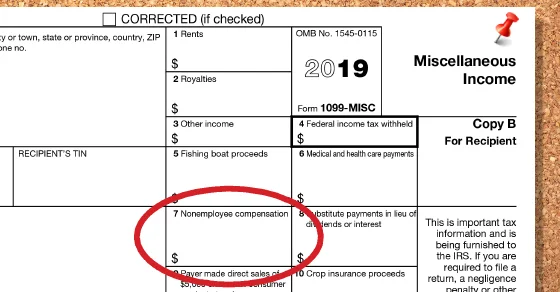
A month after the new year begins, your business may be required to comply with rules to report amounts paid to independent contractors, vendors and others. You may have to send 1099-MISC forms to those whom you pay nonemployee compensation, as well as file copies with the IRS. This task can be time consuming and there are penalties for not complying, so it’s a good idea to begin gathering information early to help ensure smooth filing.
Deadline
There are many types of 1099 forms. For example, 1099-INT is sent out to report interest income and 1099-B is used to report broker transactions and barter exchanges. Employers must provide a Form 1099-MISC for nonemployee compensation by January 31, 2020, to each noncorporate service provider who was paid at least $600 for services during 2019. (1099-MISC forms generally don’t have to be provided to corporate service providers, although there are exceptions.)
A copy of each Form 1099-MISC with payments listed in box 7 must also be filed with the IRS by January 31. “Copy A” is filed with the IRS and “Copy B” is sent to each recipient.
There are no longer any extensions for filing Form 1099-MISC late and there are penalties for late filers. The returns will be considered timely filed if postmarked on or before the due date.
A few years ago, the deadlines for some of these forms were later. But the earlier January 31 deadline for 1099-MISC was put in place to give the IRS more time to spot errors on tax returns. In addition, it makes it easier for the IRS to verify the legitimacy of returns and properly issue refunds to taxpayers who are eligible to receive them.
Gathering information
Hopefully, you’ve collected W-9 forms from independent contractors to whom you paid $600 or more this year. The information on W-9s can be used to help compile the information you need to send 1099-MISC forms to recipients and file them with the IRS. Here’s a link to the Form W-9 if you need to request contractors and vendors to fill it out: https://bit.ly/2NQvJ5O.
Form changes coming next year
In addition to payments to independent contractors and vendors, 1099-MISC forms are used to report other types of payments. As described above, Form 1099-MISC is filed to report nonemployment compensation (NEC) in box 7. There may be separate deadlines that report compensation in other boxes on the form. In other words, you may have to file some 1099-MISC forms earlier than others. But in 2020, the IRS will be requiring “Form 1099-NEC” to end confusion and complications for taxpayers. This new form will be used to report 2020 nonemployee compensation by February 1, 2021.
Help with compliance
But for nonemployee compensation for 2019, your business will still use Form 1099-MISC. If you have questions about your reporting requirements, contact us.
© 2019

Is multicloud computing right for your business?
Cloud computing — storing data and accessing apps via the Internet — has been widely adopted by businesses across industry and size. Like many technological advances, though, new derivatives continue to emerge — including so-called multicloud computing.
Under this approach, companies don’t rely on a single cloud service; rather, they distribute their data and computing needs among several providers. Popular options include Amazon Web Services (AWS), Google Cloud Platform and Microsoft Azure.
Various advantages
The strategy offers various advantages. For example, like any cloud computing arrangement, it provides scalability. As your needs expand or drop, you can readily adjust your storage capabilities to keep a lid on costs.
Multicloud computing also is a way to hedge your bets. Every cloud provider has downtime at some point but, if you use multiple clouds, you can switch critical workloads and applications to a cloud that’s up and running. And it helps you avoid “vendor lock-in,” or getting restricted to a single provider’s infrastructure, add-on services and pricing models.
Improved performance is another factor. Using several providers based relatively close to you geographically means fewer “network hops” between servers. This reduces latency (the delay between a user’s request and the provider’s response), jitter, packet loss and other disruptions.
Many businesses prefer the “a la carte” nature of multicloud computing. Different providers may have different features that you need to meet your technical or business requirements. For instance, you might choose a pricier but more secure cloud for applications with sensitive data and a cheaper alternative for less sensitive data. Similarly, a business that relies heavily on Windows might use Azure for internal operations but tap AWS for its website and Google Cloud for machine learning.
Potential pitfalls
Some companies find themselves engaging in multicloud computing without ever deciding to do so. Unintentional multiclouds can result from “shadow IT,” whereby different departments or business units start using public clouds on their own accord and then one day turn to IT for help.
Whether multicloud computing develops from shadow IT or a conscious strategic decision, it comes with potential pitfalls. Managing multiple clouds can prove complex. You can use integrated suites of software known as “cloud management platforms” to administer multiple clouds. But these platforms tend to take a “least common denominator” approach, treating multiple clouds as a single cloud by focusing on storage, network and computing functions. As a result, you may find it difficult to leverage each cloud provider’s distinctively useful features.
Total costs
Last but certainly not least, you must consider the total cost of ownership of any multicloud strategy. Although the availability of alternative providers may increase your bargaining power, the cost of paying several vendors can go beyond the upfront prices and monthly fees. You may also incur additional fees for items such as licensing and integration. We can help you perform a cost-benefit analysis of any multicloud solution you’re considering.
© 2019

Small businesses: Stay clear of a severe payroll tax penalty
One of the most laborious tasks for small businesses is managing payroll. But it’s critical that you not only withhold the right amount of taxes from employees’ paychecks but also that you pay them over to the federal government on time.
If you willfully fail to do so, you could personally be hit with the Trust Fund Recovery Penalty, also known as the 100% penalty. The penalty applies to the Social Security and income taxes required to be withheld by a business from its employees’ wages. Since the taxes are considered property of the government, the employer holds them in “trust” on the government’s behalf until they’re paid over.
The reason the penalty is sometimes called the “100% penalty” is because the person liable for the taxes (called the “responsible person”) can be personally penalized 100% of the taxes due. Accordingly, the amounts the IRS seeks when the penalty is applied are usually substantial, and the IRS is aggressive in enforcing it.
Responsible persons
The penalty can be imposed on any person “responsible” for the collection and payment of the taxes. This has been broadly defined to include a corporation’s officers, directors, and shareholders under a duty to collect and pay the tax, as well as a partnership’s partners or any employee of the business under such a duty. Even voluntary board members of tax-exempt organizations, who are generally exempt from responsibility, can be subject to this penalty under certain circumstances. Responsibility has even been extended in some cases to professional advisors.
According to the IRS, being a responsible person is a matter of status, duty and authority. Anyone with the power to see that the taxes are paid may be responsible. There is often more than one responsible person in a business, but each is at risk for the entire penalty. Although taxpayers held liable may sue other responsible persons for their contributions, this is an action they must take entirely on their own after they pay the penalty. It isn’t part of the IRS collection process.
The net can be broadly cast. You may not be directly involved with the withholding process in your business. But let’s say you learn of a failure to pay over withheld taxes and you have the power to have them paid. Instead, you make payments to creditors and others. You have now become a responsible person.
How the IRS defines “willfulness”
For actions to be willful, they don’t have to include an overt intent to evade taxes. Simply bowing to business pressures and paying bills or obtaining supplies instead of paying over withheld taxes due to the government is willful behavior for these purposes. And just because you delegate responsibilities to someone else doesn’t necessarily mean you’re off the hook.
In addition, the corporate veil won’t shield corporate owners from the 100% penalty. The liability protections that owners of corporations — and limited liability companies — typically have don’t apply to payroll tax debts.
If the IRS assesses the penalty, it can file a lien or take levy or seizure action against the personal assets of a responsible person.
Avoiding the penalty
You should never allow any failure to withhold taxes from employees, and no “borrowing” from withheld amounts should ever be allowed in your business — regardless of the circumstances. All funds withheld must be paid over on time.
If you aren’t already using a payroll service, consider hiring one. This can relieve you of the burden of withholding and paying the proper amounts, as well as handling the recordkeeping. Contact us for more information.
© 2019

A shadow board could shed light on your company’s best future
In many industries, market conditions move fast. Businesses that don’t have their ears to the ground can quickly get left behind. That’s just one reason why some of today’s savviest companies are establishing so-called “shadow” (or “mirror”) boards composed of younger, non-executive employees who are on the front lines of changing tastes and lifestyles.
Generational change
Millennials — people who were born between approximately 1981 and 1996 — have been flooding the workplace for years now. Following close behind them is Generation Z, those born around the Millennium and now coming of age a couple of decades later.
Despite this influx of younger minds and ideas, many businesses are still run solely by older boards of directors that, while packed with experience and wisdom, might not stay closely attuned to the latest demographic-driven developments in hiring, product or service development, technology, and marketing.
A shadow board of young employees that meets regularly with the actual board (or management team) can help you overcome this hurdle. Ideally, the two boards mentor each other. The older generation shares their hard-earned lessons on leadership, governance, professionalism and the like, while the younger employees keep the senior board abreast of the latest trends, concerns and communication tools among their cohort.
Other benefits
You also can tap the shadow board for their input on issues that directly affect them. For example, would they welcome a new employee benefit under consideration or regard it as irrelevant? Similarly, you can use the board to “test drive” strategies targeting their generation before you get too far down the road.
And your shadow board can serve as generator of new initiatives and innovations, both employee- and customer-facing. Some companies with shadow boards have ended up overhauling their processes, procedures and even business models based on ideas that first emerged from the younger employees’ input.
Another benefit? Shadow boards can keep traditionally job-hopping Millennials from jumping ship. Many are eager to get ahead, often before they’re equipped to do so, and they don’t hesitate to look elsewhere. Selecting younger employees for a shadow board sends them the message that you see their potential and are invested in grooming them for bigger and better things. It also facilitates succession planning, a practice too many businesses overlook.
The right approach
Don’t establish a shadow board just for appearances or without true commitment. That can do more harm than good. Younger generations see lip service for what it is, and word will spread fast if you’re ignoring the shadow board or refusing to seriously consider its input. When done right, this innovative effort can pay off in the long run for everyone involved. Our firm can help you further explore the financial and strategic feasibility of the idea.
© 2019

Thinking about converting from a C corporation to an S corporation?
The right entity choice can make a difference in the tax bill you owe for your business. Although S corporations can provide substantial tax advantages over C corporations in some circumstances, there are plenty of potentially expensive tax problems that you should assess before making the decision to convert from a C corporation to an S corporation.
Here’s a quick rundown of four issues to consider:
LIFO inventories. C corporations that use last-in, first-out (LIFO) inventories must pay tax on the benefits they derived by using LIFO if they convert to S corporations. The tax can be spread over four years. This cost must be weighed against the potential tax gains from converting to S status.
Built-in gains tax. Although S corporations generally aren’t subject to tax, those that were formerly C corporations are taxed on built-in gains (such as appreciated property) that the C corporation has when the S election becomes effective, if those gains are recognized within five years after the conversion. This is generally unfavorable, although there are situations where the S election still can produce a better tax result despite the built-in gains tax.
Passive income. S corporations that were formerly C corporations are subject to a special tax. That tax kicks in if their passive investment income (including dividends, interest, rents, royalties, and stock sale gains) exceeds 25% of their gross receipts, and the S corporation has accumulated earnings and profits carried over from its C corporation years. If that tax is owed for three consecutive years, the corporation’s election to be an S corporation terminates. You can avoid the tax by distributing the accumulated earnings and profits, which would be taxable to shareholders. Or you might want to avoid the tax by limiting the amount of passive income.
Unused losses. If your C corporation has unused net operating losses, they can’t be used to offset its income as an S corporation and can’t be passed through to shareholders. If the losses can’t be carried back to an earlier C corporation year, it will be necessary to weigh the cost of giving up the losses against the tax savings expected to be generated by the switch to S status.
Additional factors
These are only some of the factors to consider when a business switches from C to S status. For example, shareholder-employees of S corporations can’t get all of the tax-free fringe benefits that are available with a C corporation. And there may be issues for shareholders who have outstanding loans from their qualified plans. These factors have to be taken into account in order to understand the implications of converting from C to S status.
Contact us. We can explain how these factors will affect your company’s situation and come up with strategies to minimize taxes.
© 2019

At the very least, update the financials in your business plan
Every new company should launch with a business plan and keep it updated. Generally, such a plan will comprise six sections: executive summary, business description, industry and marketing analysis, management team description, implementation plan, and financials.
Now, ideally, you would comprehensively update each section every year. But if the size, shape and objectives of your company haven’t changed all that much, you may not need to make major revisions to the entire plan. However, at the very least, you should always review and revise your financials.
Explain your route
Lenders, investors and other interested parties understand that descriptions of a business or industry analysis may be subject to interpretation. But financials are a different matter — they need to add up (literally and figuratively) and contain realistic projections in today’s dollars.
For example, suppose a company with $10 million in sales in 2019 expects to double that figure over a three-year period. How will you get from Point A ($10 million in 2019) to Point B ($20 million in 2023)? Many roads may lead to the desired destination; your business plan must explain its route.
Let’s say your management team decides to double sales by hiring four new salespeople and acquiring the assets of a bankrupt competitor. These assumptions will drive the projected income statement, balance sheet and cash flow statement referenced in your business plan.
Justify assumptions
When projecting the income statement, you’ll need to make assumptions about variable and fixed costs. Direct materials are generally considered variable. Salaries and rent are usually fixed. But many fixed costs can be variable over the long term. Consider rent: Once a lease expires, you could relocate to a different facility to accommodate changes in size.
Balance sheet items — receivables, inventory, payables and so on — are generally expected to grow in tandem with revenues. The financials in your business plan must accurately and reasonably justify the assumptions you’re making about your minimum cash balance, as well as debt increases or decreases to keep the balance sheet balanced. And these amounts must be current.
From a lending perspective, your bank will be expected to fund any cash shortfalls that take place as the company grows. So, realistic cash flow projections in your business plan are particularly critical. The financials section should outline how much financing you’ll need, how you intend to use those funds and when you expect to repay the loan(s).
Keep it fresh
Your business plan needs to tell an accurate, objective story of your company — where it’s been, where it is right now and where it’s heading. Keep the whole thing as fresh as possible but pay special attention to the numbers. We can help you review your financials, arrive at reasonable assumptions, and express your objectives and projections clearly.
© 2019

Accelerate depreciation deductions with a cost segregation study
Is your business depreciating over a 39-year period the entire cost of constructing the building that houses your operation? If so, you should consider a cost segregation study. It may allow you to accelerate depreciation deductions on certain items, thereby reducing taxes and boosting cash flow. And under current law, the potential benefits of a cost segregation study are now even greater than they were a few years ago due to enhancements to certain depreciation-related tax breaks.
Depreciation basics
Business buildings generally have a 39-year depreciation period (27.5 years for residential rental properties). Most times, you depreciate a building’s structural components, including walls, windows, HVAC systems, elevators, plumbing and wiring, along with the building. Personal property — such as equipment, machinery, furniture and fixtures — is eligible for accelerated depreciation, usually over five or seven years. And land improvements, such as fences, outdoor lighting and parking lots, are depreciable over 15 years.
Often, businesses allocate all or most of their buildings’ acquisition or construction costs to real property, overlooking opportunities to allocate costs to shorter-lived personal property or land improvements. In some cases — computers or furniture, for example — the distinction between real and personal property is obvious. But the line between the two is frequently less clear. Items that appear to be “part of a building” may in fact be personal property, like removable wall and floor coverings, removable partitions, awnings and canopies, window treatments, signs and decorative lighting.
In addition, certain items that otherwise would be treated as real property may qualify as personal property if they serve more of a business function than a structural purpose. This includes reinforced flooring to support heavy manufacturing equipment, electrical or plumbing installations required to operate specialized equipment, or dedicated cooling systems for data processing rooms.
Identifying and substantiating costs
A cost segregation study combines accounting and engineering techniques to identify building costs that are properly allocable to tangible personal property rather than real property. Although the relative costs and benefits of a cost segregation study depend on your particular facts and circumstances, it can be a valuable investment.
Speedier depreciation tax breaks
The Tax Cuts and Jobs Act (TCJA) enhances certain depreciation-related tax breaks, which may also enhance the benefits of a cost segregation study. Among other things, the act permanently increased limits on Section 179 expensing, which allows you to immediately deduct the entire cost of qualifying equipment or other fixed assets up to specified thresholds.
The TCJA also expanded 15-year-property treatment to apply to qualified improvement property. Previously this break was limited to qualified leasehold-improvement, retail-improvement and restaurant property. And it temporarily increased first-year bonus depreciation to 100% (from 50%).
Making favorable depreciation changes
Fortunately, it isn’t too late to get the benefit of speedier depreciation for items that were incorrectly assumed to be part of your building for depreciation purposes. You don’t have to amend your past returns (or meet a deadline for claiming tax refunds) to claim the depreciation that you could have already claimed. Instead, you can claim that depreciation by following procedures, in connection with the next tax return that you file, that will result in “automatic” IRS consent to a change in your accounting for depreciation.
Cost segregation studies can yield substantial benefits, but they’re not right for every business. We must judge whether a study will result in overall tax savings greater than the costs of the study itself. To find out whether this would be worthwhile for you, contact us.
© 2019

Deciding whether a merger or acquisition is the right move
Merging with, or acquiring, another company is one of the best ways to grow rapidly. You might be able to significantly boost revenue, literally overnight, by acquiring another business. In contrast, achieving a comparable rate of growth organically — by increasing sales of existing products and services or adding new product and service lines — can take years.
There are, of course, multiple factors to consider before making such a move. But your primary evaluative objective is to weigh the potential advantages against the risks.
Does it make sense?
On the plus side, an acquisition might enable your company to expand into new geographic areas and new customer segments more quickly and easily. You can do this via a horizontal acquisition (acquiring another company that’s similar to yours) or a vertical acquisition (acquiring another company along your supply chain).
There are also some potential drawbacks to completing a merger or acquisition. It’s a costly process from both financial and time-commitment perspectives. In a worst-case scenario, an ill-advised merger or acquisition could spell doom for a business that overextends itself financially or overreaches its functional capabilities.
Thus, you should determine how much the transaction will cost and how it will be financed before beginning the M&A process. Also try to get an idea of how much time you and your key managers will have to spend on M&A-related tasks in the coming months — and how this could impact your existing operations.
You’ll also want to ensure that the cultures of the two merging businesses will be compatible. Mismatched corporate cultures have been the main cause of numerous failed mergers, including some high-profile megamergers. You’ll need to plan carefully for how two divergent cultures will be blended together.
Can you reduce the risks?
The best way to reduce the risk involved in buying another business is to perform solid due diligence on your acquisition target. Your objective should be to confirm claims made by the seller about the company’s financial condition, clients, contracts, employees and management team.
The most important step in M&A due diligence is a careful examination of the company’s financial statements — specifically, the income statement, cash flow statement and balance sheet. Also scrutinize the existing client base and client contracts (if any exist) because projected future earnings and cash flow will largely hinge on these.
Finally, try to get a good feel for the knowledge, skills and experience possessed by the company’s employees and key managers. In some circumstances, you might consider offering key executives ownership shares if they’ll commit to staying with the company for a certain length of time after the merger.
Who can help?
The decision to merge with another business or acquire another company is rarely an easy one. We can help you perform the financial analyses and project the tax implications of any prospective deal to bring the idea better into focus.
© 2019

Setting up a Health Savings Account for your small business
Given the escalating cost of employee health care benefits, your business may be interested in providing some of these benefits through an employer-sponsored Health Savings Account (HSA). For eligible individuals, HSAs offer a tax-advantaged way to set aside funds (or have their employers do so) to meet future medical needs. Here are the key tax benefits:
Contributions that participants make to an HSA are deductible, within limits.
Contributions that employers make aren’t taxed to participants.
Earnings on the funds within an HSA aren’t taxed, so the money can accumulate year after year tax free.
HSA distributions to cover qualified medical expenses aren’t taxed.
Employers don’t have to pay payroll taxes on HSA contributions made by employees through payroll deductions.
Who is eligible?
To be eligible for an HSA, an individual must be covered by a “high deductible health plan.” For 2019, a “high deductible health plan” is one with an annual deductible of at least $1,350 for self-only coverage, or at least $2,700 for family coverage. For self-only coverage, the 2019 limit on deductible contributions is $3,500. For family coverage, the 2019 limit on deductible contributions is $7,000. Additionally, annual out-of-pocket expenses required to be paid (other than for premiums) for covered benefits cannot exceed $6,750 for self-only coverage or $13,500 for family coverage.
An individual (and the individual’s covered spouse, as well) who has reached age 55 before the close of the tax year (and is an eligible HSA contributor) may make additional “catch-up” contributions for 2019 of up to $1,000.
Employer contributions
If an employer contributes to the HSA of an eligible individual, the employer’s contribution is treated as employer-provided coverage for medical expenses under an accident or health plan and is excludable from an employee’s gross income up to the deduction limitation. There’s no “use-it-or-lose-it” provision, so funds can be built up for years. An employer that decides to make contributions on its employees’ behalf must generally make comparable contributions to the HSAs of all comparable participating employees for that calendar year. If the employer doesn’t make comparable contributions, the employer is subject to a 35% tax on the aggregate amount contributed by the employer to HSAs for that period.
Distributions
HSA distributions can be made to pay for qualified medical expenses, which generally mean those expenses that would qualify for the medical expense itemized deduction. They include expenses such as doctors’ visits, prescriptions, chiropractic care and premiums for long-term care insurance.
If funds are withdrawn from the HSA for other reasons, the withdrawal is taxable. Additionally, an extra 20% tax will apply to the withdrawal, unless it’s made after reaching age 65, or in the event of death or disability.
As you can see, HSAs offer a flexible option for providing health care coverage, but the rules are somewhat complex. Contact us if you’d like to discuss offering this benefit to your employees.
© 2019

Tax Guide: Individual Gift Tax Return
Do you need to file gift tax returns?
Avoid these common mistakes
For 2019, the lifetime gift and estate tax exemption has reached a whopping $11.40 million ($22.80 million for married couples). As a result, few people will be subject to federal gift taxes. If your wealth is well within the exemption amount, does that mean there’s no need to file gift tax returns? Not necessarily. There are many situations in which it’s necessary (or desirable) to file Form 709, “United States Gift (and Generation-Skipping Transfer) Tax Return” — even if you’re not liable for any gift taxes.
All gifts are taxable, except . . .
The federal gift tax regime begins with the assumption that all transfers of property by gift (including below-market sales or loans) are taxable, and then sets forth several exceptions. Nontaxable transfers that need not be reported on Form 709 include:
· Gifts of present interests (as opposed to future interests; see below) within the gift tax annual exclusion amount ($15,000 per recipient in 2019),
· Direct payments of qualifying medical or educational expenses on behalf of an individual (see “Medical and educational expenses: Direct payments only”),
· Gifts to political organizations and certain tax-exempt organizations,
· Deductible charitable gifts, and
· Gifts to your U.S.-citizen spouse, either outright or to a trust that meets certain requirements, or gifts to your noncitizen spouse within a special annual exclusion amount ($155,000 for 2019).
If all your gifts for the year fall into these categories, no gift tax return is required. But gifts that don’t meet these requirements are generally considered taxable — and must be reported on Form 709 — even if they’re shielded from tax by the lifetime exemption.
Traps to avoid
If you make gifts during the year, consider whether you’re required to file Form 709. And watch out for these common traps:
Future interests. Gifts of future interests, such as transfers to a trust, aren’t covered by the gift tax annual exclusion, so you’re required to report them on Form 709 even if they’re less than $15,000. Be aware, however, that it’s possible to have gifts in trust meet the present interest requirement by giving beneficiaries Crummey withdrawal powers (the right to withdraw a contribution for a limited time after it’s made).
Spousal gifts. If you make a gift to a trust for your spouse’s benefit and want the gift to qualify as a nontaxable transfer, the trust must 1) provide that your spouse is entitled to all the trust’s income for life, payable at least annually, 2) give your spouse a general power of appointment over its assets and 3) not be subject to any other person’s power of appointment. Otherwise, the gift must be reported. And be careful with gifts to a noncitizen spouse: If they exceed the $155,000 annual exclusion, they must be reported regardless of whether they’re outright gifts or gifts in trust.
Gift splitting. Spouses may elect to split a gift to a child or other donee, so that each spouse is deemed to have made one-half of the gift, even if one spouse wrote the check. This allows married couples to combine their annual exclusions and give up to $30,000 to each recipient in 2019. To make the election, the donor spouse must file Form 709, and the other spouse must sign a consent or, in some cases, file a separate gift tax return. Keep in mind that, once you make this election, you and your spouse must split all gifts to third parties during the year.
529 plans. If you make gifts to a 529 college savings plan, you have the option of bunching five years’ worth of annual exclusions into the first year. So, for example, you can contribute $75,000 to the plan ($150,000 if you and your spouse split the gift) and treat the gift as if it were made over the next five years for annual exclusion purposes. To take advantage of this benefit, you must file an election on Form 709.
Consider filing voluntarily
It may be a good idea to file a gift tax return even if it’s not required. For example, if you make annual exclusion gifts of difficult-to-value assets, such as interests in a closely held business, a gift tax return that meets “adequate disclosure” requirements will trigger the three-year limitations period for audits.
Suppose you transfer business interests valued at $10 million over a period of years, through a combination of tax-free gifts to your spouse and annual exclusion gifts to your children. If the IRS finds that the interests were worth $15 million, which exceeds the lifetime exemption amount, it can assess gift taxes plus penalties and interest. If you don’t file regular gift tax returns, the IRS has unlimited time to challenge the values of your gifts.
Stay on the right side of the IRS
A smart gifting strategy continues to offer significant benefits for you and your loved ones. However, to keep from running afoul of the IRS, it’s critical to know when you need to file a gift tax return. We can help you in that determination.
Sidebar: Medical and educational expenses: Direct payments only
Paying tuition or unreimbursed medical expenses on behalf of a child or other loved one is a great strategy for making unlimited tax-free gifts without using up any of your $15,000 annual exclusion or $11.40 million lifetime exemption. But it works only if you make the payments directly to a qualifying educational institution or medical provider.
A common mistake is for a parent or grandparent to advance the child the funds he or she needs to pay the expenses or to reimburse him or her for expenses that have already been paid. These payments are treated as gifts to the child, which must be reported on Form 709 if they exceed the annual exclusion amount.
© 2019

Tax Guide: Business Repair vs. Improvement
Did you repair your business property or improve it?
Repairs to tangible property, such as buildings, machinery, equipment or vehicles, can provide businesses a valuable current tax deduction — as long as the so-called repairs weren’t actually “improvements.”
The costs of incidental repairs and maintenance can be immediately expensed and deducted on the current year’s income tax return. But costs incurred to improve tangible property must be capitalized and recovered through depreciation.
Betterment, restoration or adaptation
Generally, a cost must be depreciated if it results in an improvement to a building structure or any of its systems (for example, the plumbing or electrical system), or to other tangible property. An improvement occurs if there was a betterment, restoration or adaptation of the unit of property.
Under the “betterment test,” you generally must depreciate amounts paid for work that is reasonably expected to materially increase the productivity, efficiency, strength, quality or output of a unit of property or that is a material addition to a unit of property.
Under the “restoration test,” you generally must depreciate amounts paid to replace a part (or combination of parts) that is a major component or a significant portion of the physical structure of a unit of property.
Under the “adaptation test,” you generally must depreciate amounts paid to adapt a unit of property to a new or different use — one that isn’t consistent with your ordinary use of the unit of property at the time you originally placed it in service.
Safe harbors
A couple of IRS safe harbors can help distinguish between repairs and improvements:
1. Routine maintenance safe harbor. Recurring activities dedicated to keeping property in efficient operating condition can be expensed. These are activities that your business reasonably expects to perform more than once during the property’s “class life,” as defined by the IRS.
Amounts incurred for activities outside the safe harbor don’t necessarily have to be depreciated, though. These amounts are subject to analysis under the general rules for improvements.
2. Small business safe harbor. For buildings that initially cost $1 million or less, qualified small businesses may elect to deduct the lesser of $10,000 or 2% of the unadjusted basis of the property for repairs, maintenance, improvements and similar activities each year. A qualified small business is generally one with gross receipts of $10 million or less.
More to learn
To learn more about these safe harbors and other ways to maximize your tangible property deductions, contact us.
© 2019

Tax Guide: Individual Investment Accounts
Taxable vs. tax-advantaged: Where to hold investments
When investing for retirement or other long-term goals, people usually prefer tax-advantaged accounts, such as IRAs, 401(k)s or 403(b)s. Certain assets are well suited to these accounts, but it may make more sense to hold other investments in taxable accounts.
Know the rules
Some investments, such as fast-growing stocks, can generate substantial capital gains. These gains are recognized and generally taxable when you sell a security for more than you paid for it.
If you’ve owned that position for over a year, you qualify for the long-term gains rate, generally 15% or 20%. The long-term gains rate also applies to qualified dividends. In contrast, short-term gains, on investments held a year or less, are taxed at your ordinary-income tax rate — which might be as high as 37%. Nonqualified dividends and interest income are also generally subject to your ordinary-income rate. The 3.8% net investment income tax (NIIT) might also apply to capital gains, dividends and interest, depending on your income.
But if an investment is held in a tax-deferred account, like a traditional IRA, 401(k) or 403(b), there’s no tax liability until you take distributions from the account. At that time, the distribution is taxed at your ordinary-income tax rate. However, the NIIT doesn’t apply to retirement plan distributions.
Choose tax efficiency
Generally, the more tax efficient an investment, the more benefit you’ll get from owning it in a taxable account. Conversely, investments that lack tax efficiency normally are best suited to tax-advantaged vehicles.
Consider municipal bonds (“munis”), either held individually or through mutual funds. Munis are attractive to tax-sensitive investors because their income is exempt from federal income taxes and sometimes state and local income taxes. Because you don’t get a double benefit when you own an already tax-advantaged security in a tax-advantaged account, holding munis in your 401(k) or IRA would result in a lost opportunity.
Similarly, tax-efficient investments such as passively managed index mutual funds or exchange-traded funds, or long-term stock holdings, are generally appropriate for taxable accounts. These securities are more likely to generate long-term capital gains, which have more favorable tax treatment. Securities that generate more of their total return via capital appreciation or that pay qualified dividends are also better taxable account options.
Take advantage of income
What investments work best for tax-advantaged accounts? Taxable investments that tend to produce much of their return in income. This category includes corporate bonds, especially high-yield bonds, as well as real estate investment trusts (REITs), which are required to pass through most of their earnings as shareholder income. Most REIT dividends are nonqualified and therefore taxed at your ordinary-income rate.
Another tax-advantaged-appropriate investment may be an actively managed mutual fund. Funds with significant turnover — meaning their portfolio managers are actively buying and selling securities — have increased potential to generate short-term gains that ultimately get passed through to you. Because short-term gains are taxed at a higher rate than long-term gains, these funds would be less desirable in a taxable account.
Get specific advice
The above concepts are only general suggestions. Please contact us for specific advice on what may be best for you.
© 2019

Tax Guide: Individual Charitable IRA Rollover
Charitable IRA rollover eases tax pain of RMDs
One downside of contributing to a traditional IRA is that, once you reach age 70½, you must begin taking required minimum distributions (RMDs) — and pay taxes on those distributions — whether you need the money or not. But if you’re charitably inclined, you can use a qualified charitable distribution (QCD) to avoid taxes on up to $100,000 in RMDs per year.
Also known as a “charitable IRA rollover,” a QCD is a direct transfer from your IRA to an eligible charity. It counts as a distribution for RMD purposes, but it’s excluded from your income. And it has certain tax advantages over traditional charitable contributions.
Advantage of QCDs over ordinary donations
When you receive an RMD, it’s taxable to the extent it’s attributable to deductible contributions and earnings on those contributions. (Amounts attributable to nondeductible contributions are tax-free.)
One strategy for reducing these taxes is to donate the taxable portion (or an equivalent amount) to charity. If the donation is fully deductible, it will offset the taxable income that’s generated by the distribution. Depending on your tax situation, however, this strategy may be less effective than a QCD:
· A charitable deduction will benefit you only if you itemize. And that’s less likely now that the Tax Cuts and Jobs Act (TCJA) has nearly doubled the standard deduction.
· Even if you itemize, adjusted gross income (AGI) limits may reduce your charitable deductions. For instance, deductions for cash gifts to public charities are currently limited to 60% of AGI.
· By boosting your income, IRA distributions may trigger AGI-based rules that punch up certain taxes or deflate the benefits of certain tax breaks.
A QCD avoids these issues because it bypasses your income altogether. It allows you to take the equivalent of a charitable deduction — regardless of your income level or whether you itemize — and it won’t increase your AGI. Another advantage of QCDs is that they’re deemed to come from the taxable portion of your IRA first, increasing the portion of the remaining balance that’s nontaxable.
QCD requirements
If you’re considering a QCD, you must meet several requirements:
· You must be at least 70½ at the time of the distribution. (Reaching that age during the tax year isn’t enough.)
· The IRA must distribute the funds directly to an eligible charity — generally, a public charity, private operating foundation or “conduit” private foundation.
· The donation must be “otherwise deductible.” In other words, it would have been fully deductible (disregarding AGI limits) had you funded it with non-IRA assets. If you receive something of value in exchange for your gift (tickets to an event, for example), it’s not a QCD.
· The distribution must be “otherwise taxable.” It’s not a QCD to the extent it would be tax-free if distributed to you directly.
In addition, QCDs are subject to the same substantiation requirements as other charitable donations.
A tax-efficient strategy
If you don’t need your IRA funds for living expenses and you plan to donate to charity anyway, a QCD offers a tax-efficient strategy for satisfying your RMD requirements. The TCJA may enhance the advantages of QCDs because it increased standard deduction amounts, but keep in mind that these amounts are scheduled to return to their previous levels in 2026. Contact us for help determining the best RMD and charitable giving strategies for you.
© 2019

Tax Guide: Business Loss Deductions
Excess business loss rule may be unfavorable to you
Sole proprietorships and pass-through entity structures, which include partnerships, S corporations and certain limited liability companies (LLCs), provide owners with some valuable tax benefits, such as avoidance of double taxation and the potential ability to deduct losses from the business on their individual tax returns. But the Tax Cuts and Jobs Act (TCJA) has placed some limitations on deducting business losses. Here’s a look at the changes in the rules and how they might affect you.
The way it was
Before the TCJA, an individual taxpayer’s business losses could usually be fully deducted in the tax year when they arose. That was the result unless the passive activity loss (PAL) rules or some other provision of tax law limited that favorable outcome, or the business loss was so large that it exceeded taxable income from other sources, creating a net operating loss (NOL).
Under prior law, you could carry back an NOL to the two preceding tax years. You also could carry it forward for up to 20 tax years.
The way it is now
Through 2025, the TCJA changes the rules for deducting an individual taxpayer’s business losses. Unfortunately, the changes are unfavorable to affected taxpayers.
Before we look at the changes, it’s important to review how the PAL rules work. They may apply if your business is a rental operation or you don’t actively participate in the business.
In general, the PAL rules allow you to deduct passive losses only to the extent you have passive income from other sources, such as positive income from other business or rental activities or gains from selling them. Passive losses that can’t be currently deducted are carried forward to future years until you either have sufficient passive income to absorb them or you sell the activity that produced the losses.
If you successfully cleared the hurdles imposed by the PAL rules, the TCJA places a new hurdle in front of you: For tax years beginning in 2018 through 2025, you can’t deduct an “excess business loss” in the current year. For 2019, an excess business loss is the excess of your aggregate business deductions for the tax year over the sum of $255,000 (or $510,000 if you’re a married joint-filer) and your aggregate business income and gains for the tax year.
The excess business loss is carried forward to the following tax year and can be deducted under the rules for NOL carryforwards. For NOLs that arise in tax years ending after December 31, 2017, you generally can’t use an NOL carryforward to shelter more than 80% of your taxable income in the carryforward year. (Under prior law, you could usually shelter up to 100%.)
In addition, NOLs that arise in tax years beginning after December 31, 2017, can’t be carried back to an earlier tax year. Instead, they can be carried forward indefinitely.
More considerations
As noted, the new loss limitation rules apply after applying the PAL rules. So, if the PAL rules disallow your business or rental activity loss, the loss limitation rules are irrelevant.
For business losses passed through to individuals from S corporations, partnerships and LLCs that are treated as partnerships for tax purposes, the new loss limitation rules apply at the owner level. In other words, each owner’s allocable share of business income, gain, deduction or loss is passed through to the owner and reported on the owner’s personal federal income tax return for the owner’s tax year that includes the end of the entity’s tax year.
Practical impact
The rationale underlying the new loss limitation rules is to further restrict the ability of individual taxpayers to use current-year business losses (including losses from rental activities) to offset income from other sources, such as salary, self-employment income, interest, dividends and capital gains.
The practical impact is that, if you have excess business losses for 2019, the requirement that such losses must be carried forward as an NOL forces you to wait at least one year to get any tax benefit from those excess losses.
If it looks like your business may generate a loss in 2019, contact us to help you determine the impact of the TCJA on your tax situation.
© 2019

6 ways to ensure your marketing plan drives sales
“Love and marriage,” goes the old song: “…You can’t have one without the other.” This also holds true for sales and marketing. Even the best of sales staffs will struggle if not supported by a well-researched and carefully executed marketing plan. Here are six ways to ensure your marketing plan is likely to drive strong sales:
1. Keep customers aware of all your products and services. Among the fundamental objectives of any marketing plan is to familiarize those who buy from you with everything you’re offering. But what often happens is that customers get overly focused on just a few products or services, which in turn limits sales. Make sure your marketing plan maintains the visibility of your total product or service line.
2. Distinguish your products and services from those of competitors. Your salespeople will stand a much greater chance of success if your customers believe you’re the only place to get precisely what they’re looking for. Your marketing plan should emphasize the distinctive value offered by your products or services and how they differ from those of competitors. A key part of this effort involves monitoring the competition’s marketing activities and responding in kind.
3. Benchmark your marketing/advertising budgets. Are competitors outspending you? If so, your sales staff is fighting an uphill battle. To find out, use competitive intelligence and publicly available industry data to determine the average marketing and advertising budgets for companies of similar size and specialty in your area.
4. Search for new markets. While your sales staff is out on the front lines, your marketing team needs to be spending time back at the office looking for additional buyers (or types of buyers). Undertake this research carefully and methodically. When you believe you’ve found a new market, adjust your marketing plan as necessary and train salespeople on how to best traverse this unfamiliar terrain.
5. Track new leads generated through marketing. A good marketing plan not only keeps existing customers engaged and informed, but also pulls in new prospects. Do you know how successful your company has been at doing so? Your sales team may be able to generate some leads themselves, but your marketing department must do its fair share. If it’s not, something needs to change.
6. Update your marketing plan regularly. Coming up with a comprehensive, viable marketing plan isn’t easy. Once they’ve got one, many businesses make the mistake of sticking with it too long, leaving their sales departments to struggle in a dynamic, ever-changing marketplace.
Review your marketing plan often, at least quarterly, and adjust it based on both hard numbers (metrics and sales results) and feedback from your sales staff. Our firm can help you identify, track and better understand the analytical data that aligns a good marketing plan with strong sales figures.
© 2019